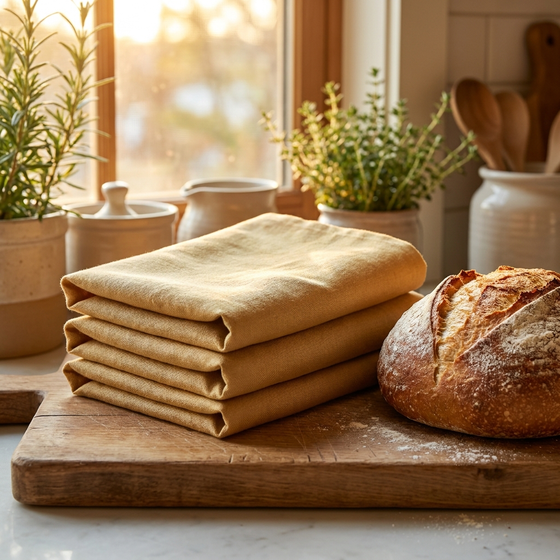
A 250-year-old French method, tested in a modern American kitchen.

10 Reasons Your Homemade Sourdough Only Lasts 3 Days (And How a Forgotten French Method Finally Fixed All of Them)

Margaux Whitfield

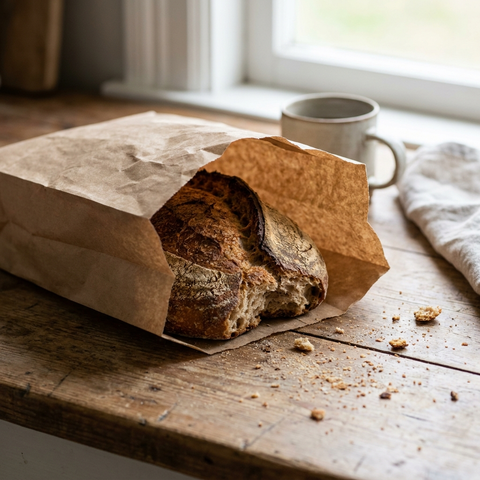
By Margaux Whitfield

I threw away $480 worth of homemade bread last year before I figured this out.

For three years, I had accepted that homemade sourdough only lasts three days. Every Tuesday morning was the same: check the loaf, find soft crust or green mold, scrape half of it into the bin, feel guilty.

I tried plastic bags. I tried paper. I tried bread bins. I tried freezing every loaf the moment it cooled. I bought four different natural beeswax bags from Amazon. Every single one failed within weeks.

Then I discovered the 10 reasons this keeps happening, and the 250-year-old French method that fixes all of them.

It is not the bread. It is the bag.

Plastic Bags Trigger The Toxic Greenhouse Effect

Reason #1: Plastic Bags Trigger The Toxic Greenhouse Effect

What I thought:

Plastic protects bread from air and locks in freshness.

The truth:

Plastic traps 100% of the moisture. It does not protect bread. It suffocates it.

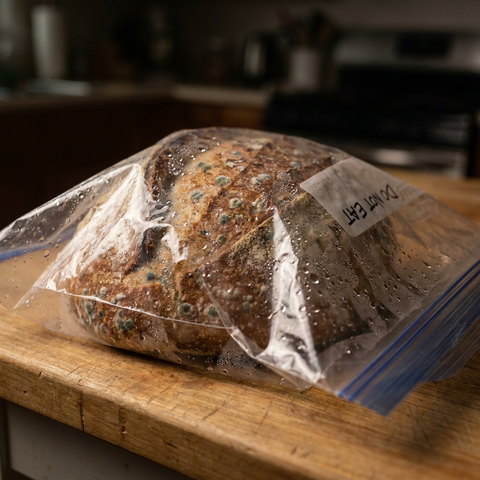
A freshly baked loaf releases water vapor for several days as it cools. In a sealed plastic bag, that vapor has nowhere to go. It condenses on the inside of the bag, creating a tropical microclimate bakers call The Toxic Greenhouse Effect.

This is why bread sealed in plastic actually molds faster than bread left uncovered.

I stored a fresh loaf of sourdough inside, and within 48 hours, the bottom was covered in green mold.


Verified buyer, 1-star

The fix:

A semi-permeable barrier that lets excess moisture escape slowly without drying the loaf out.
Your Fridge Makes Bread Go Stale Six Times Faster

Reason #2: Your Fridge Makes Bread Go Stale Six Times Faster

What I thought:

The fridge slows decay, so it must keep bread fresh longer.

The truth:

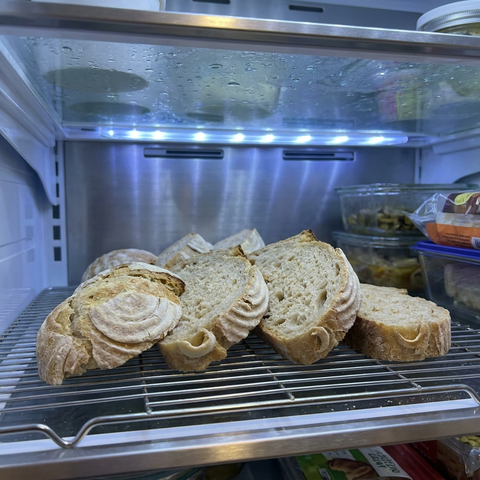
Refrigeration is the single worst place you can put a fresh loaf.

There is a chemical process called starch retrogradation. It is what makes bread go stale. This happens fastest at temperatures between 35 and 40 degrees. That is exactly the temperature inside your fridge.

A loaf at room temperature stales at a baseline rate. The same loaf in the fridge stales six times faster.

The fix:

Room-temperature storage with active mold prevention built into the fabric itself.

Paper Bags Turn Bread Into Cardboard Overnight

Reason #3: Paper Bags Turn Bread Into Cardboard Overnight

What I thought:

Paper is breathable and natural, so it must be a good middle ground.

The truth:

Paper releases too much moisture, way too fast.

The bread releases its moisture into the dry air through the paper at full speed. Within twenty-four hours, the crust has gone from crackling to brittle to chewable like sawdust.

Paper prevents mold but creates a different failure: total dehydration.

The fix:

A controlled, semi-permeable release of moisture. Not full retention, not full escape.

Bread Boxes Are Decorative Furniture, Not Storage Solutions

Reason #4: Bread Boxes Are Decorative Furniture, Not Storage Solutions

What I thought:

A dedicated bread box must work, otherwise why would they sell so many?

The truth:

Bread boxes are containers, not regulators.

A bread box does exactly two things. It blocks light, and it slows airflow. Neither of these is what causes bread to go stale or moldy. The actual variables are humidity, temperature, and antimicrobial agents in the contact surface.

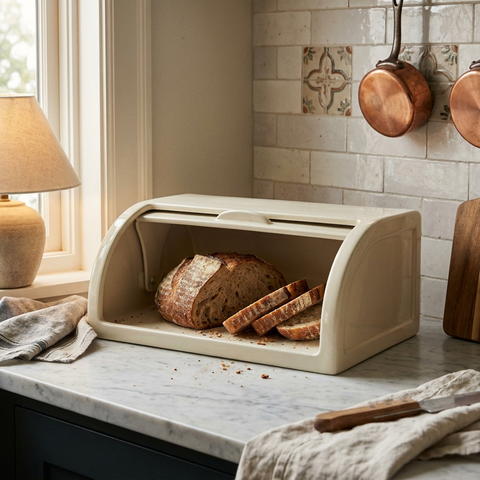
I tested a $65 ceramic bread box from Williams Sonoma. It gave me one extra day before mold.

The fix:

Active moisture regulation, not passive containment.

Tea Towels and Cotton Bags Are Inconsistent and Unreliable

Reason #5: Tea Towels and Cotton Bags Are Inconsistent and Unreliable

What I thought:

Natural fibers like cotton or linen must be better than plastic.

The truth:

Plain fabric cannot regulate moisture evenly without a sealing agent.

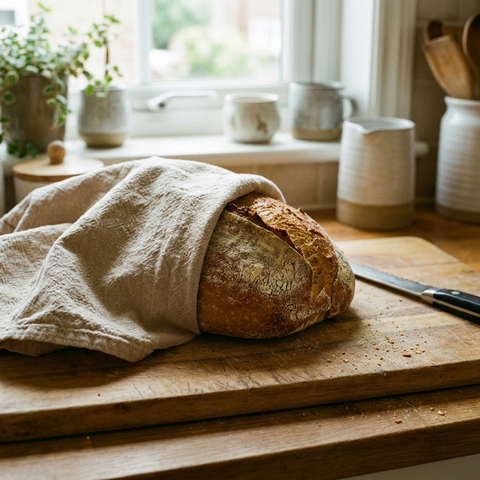
Sometimes a tea towel works for an extra day or two. Most of the time, the edges of the loaf dry out while the middle traps just enough moisture to mold.

A piece of cotton with a thin coat of wax on top is functionally a glorified tea towel that smells like honey for the first wash.

The fix:

Fabric with the right structural fiber (linen, not cotton) plus a deeply infused antibacterial coating.

Whole Grain and Sourdough Need Different Storage Than White Bread

Reason #6: Whole Grain and Sourdough Need Different Storage Than White Bread

What I thought:

All bread storage works the same.

The truth:

Whole wheat and sourdough release moisture at a higher rate than commercial white bread.

Whole grain flour contains the wheat germ, which is rich in natural oils. Those oils go rancid faster, and the flour holds and releases more water than refined flour.

Sourdough has a higher hydration ratio. It needs storage that handles a higher peak moisture load and tapers off correctly.

The fix:

Storage that adapts to the moisture profile of artisan bread.

Freezing Does Not Preserve Bread. It Just Hides the Problem.

Reason #7: Freezing Does Not Preserve Bread. It Just Hides the Problem.

What I thought:

If nothing else works, just slice it, freeze it, toast it as needed.

The truth:

Frozen bread is not bread. It is bread that needs to be rescued.

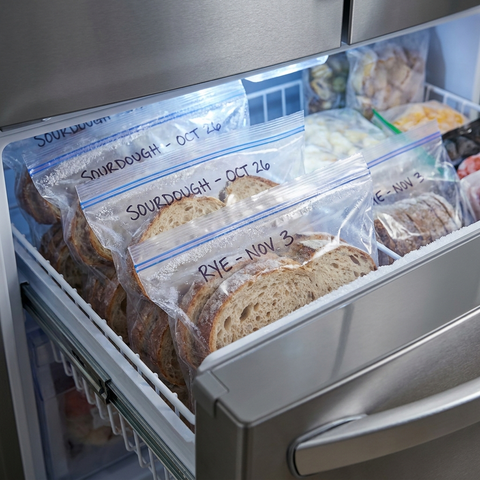
For a year, I sliced and froze every loaf the moment it cooled. I had labelled bags. A rotation system. It felt responsible. It also meant I never ate fresh bread again.

Choosing toast in the morning is a pleasure. Needing toast every morning because your storage failed is something else.

Trying to make one loaf last a week without tasting like sadness.


Reddit, r/Sourdough

The fix:

Fresh bread that lasts a full week at room temperature. No freezing required.

Real Beeswax Is the Hero. Most Online Sellers Are Hiding Plastic Behind It

Reason #8: Real Beeswax Is the Hero. Most Online Sellers Are Hiding Plastic Behind It

What I thought:

All beeswax bread bags are roughly equivalent.

The truth:

Real beeswax, properly infused into linen, is exactly what keeps bread fresh for a week. The problem is most online sellers cut corners with cotton, TPU plastic, and a thin coat of wax sprayed on top.

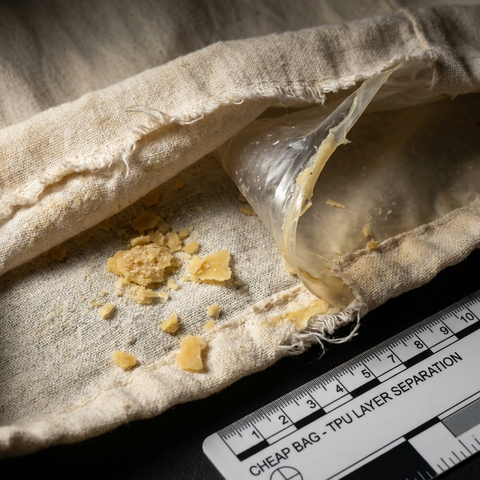
I tested four natural beeswax bread bags from Amazon. Each claimed 100% beeswax. Each failed within weeks. When I cut one open, here is what I actually found: thin see-through cotton (not real linen), wax that flaked off after three washes, a hidden inner layer of TPU plastic, and zero OEKO-TEX or third-party certification.

It is not the beeswax that fails. It is the cheap manufacturing that fakes it.

The fix:

A beeswax bread bag where pure beeswax is genuinely pressed and saturated into French flax linen, the way it has been done for centuries. No spray. No plastic film hidden inside. Real material, real method, OEKO-TEX certified.

European Households Were Doing This For Centuries Before Plastic

Reason #9: European Households Were Doing This For Centuries Before Plastic

What I thought:

Three-day freshness is just how homemade bread works in 2026.

The truth:

European grandmothers kept bread fresh for a full week using waxed linen cloth.

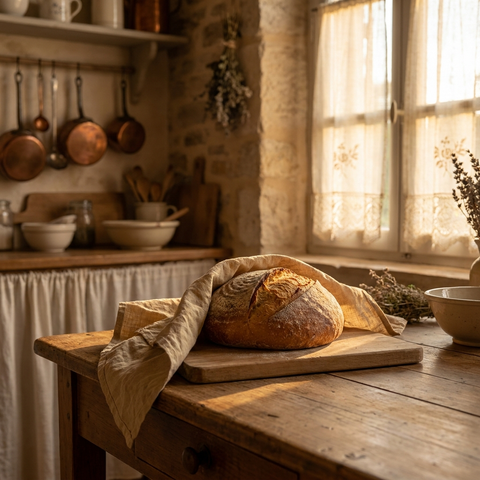
From the 13th century onwards, French farmwives wrapped every loaf in beeswax-treated linen. German villages did the same. Italian nonnas. Spanish abuelas. The bread lasted six or seven days, with no mold, no staleness.

The method survived for around eight hundred years. Then plastic became cheap in the 1960s, and within one generation, the old methods were forgotten.

The fix:

Bring back the traditional beeswax bread bag, made with the original materials.

The Science Has a Name: The Dual-Action Breathable Barrier

Reason #10: The Science Has a Name: The Dual-Action Breathable Barrier

What I thought:

Linen is just another fabric. Beeswax is just another coating.

The truth:

Linen and cotton are not the same fiber. Pure beeswax and synthetic wax are not the same molecule.

European flax linen has measurable properties cotton does not: hollow fibers that wick excess moisture away, absorbs up to 20% of its weight in moisture without feeling damp (cotton starts to feel wet at 7%), releases moisture three times faster than cotton.

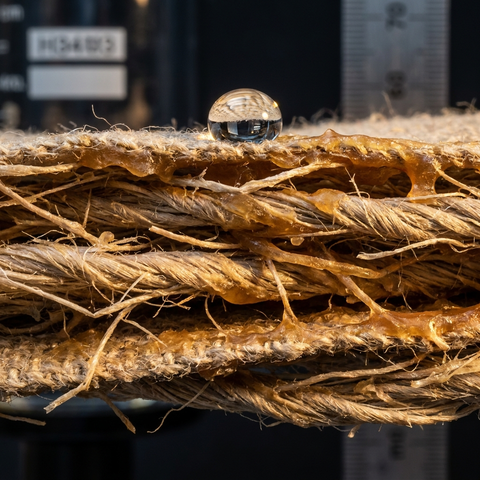
Beeswax is one of the most powerful natural antibacterial materials. When pressed into a fabric weave, not sprayed on top, it creates a hydrophobic matrix that regulates moisture and inhibits microbial growth simultaneously.

Think of it as a Gore-Tex jacket for your bread. It blocks the outside, but lets the inside breathe just enough to stay perfect.

I have tried bread boxes, plastic bags, paper bags, and tea towels. Nothing comes close. My bread stays fresh for 5 to 7 days.


Verified buyer, 5-star

The fix:

A genuine beeswax bread bag built on this Dual-Action Breathable Barrier: pure European linen, infused with real beeswax.


The Solution That Fixed All 10 Problems

After three years of waste, I finally found what actually works.

Not cheap Amazon knockoffs. Not bread bins. Not freezing every loaf and hating my own bread.

Real beeswax saturation. Made the traditional way.

I found a brand called OSLO, started by a small team that sources its linen from the same Norman weavers who have been making French flax for the bakeries of Lyon and Paris for centuries. Their grandmothers used beeswax-treated linen to keep bread fresh for a week. OSLO simply rebuilt that exact bag, with the modern OEKO-TEX certification.

Here is what makes it different:

  • Pure French flax linen fully infused with real beeswax (not thin cotton with spray coating)
  • No TPU, no plastic, no synthetic blends. OEKO-TEX certified, lab-verified
  • Bread stays bakery-fresh for 5 to 7 days consistently
  • One bag lasts 2 to 3 years of daily use

After only 2 weeks of use, OSLO customers reported:

92%

saw their bread stay fresh for over a week

88%

noticed no mold even after 10+ days

76%

stopped using plastic bags entirely after switching

94%

would recommend OSLO to fellow home bakers

I have been using mine for four months now. I bake every Saturday. I finish the loaf by Friday. I have not used the toaster out of necessity once. The crust still cracks under my thumb on day five.

What other home bakers are saying

(Verified reviews, 4.8 stars across 17,385 reviews)

"My sourdough still tastes like Sunday morning, on Friday."

Sarah M.✓ verified buyer

"The best way to keep my sourdough fresh, finally. These OSLO bags have been a game changer. They keep my loaves soft and fresh so much longer than anything else I have tried."

Raquel B.✓ verified buyer

"My husband bought this and I rolled my eyes. Thought it was just another gimmick. He used it for a week and was about to take credit, so I tried it myself just to prove him wrong. I cannot believe I am typing this but he was right."

Margaret Callahan✓ verified buyer

"Two weeks fresh, no mold, I am shocked."

PPerk H.✓ verified buyer

"Finally something that lives up to the hype."

T. Norman✓ verified buyer


Special Offer

OSLO offers three configurations. Here is what I picked, and why.

1 Bag

$29.99$59.99Save $30

One OSLO Heritage Bread Bag. The entry option if you want to test the method on one loaf at a time.

2 Bags

$49.99$119.99Save $70 + Free Shipping

Two bags, one for the fresh loaf and one for freezer or gifting.

Annual Bread Waste Calculation (Why I Did Not Hesitate)

Before OSLO:

  • Flour cost: $7.50 per loaf (organic stoneground)
  • Baking frequency: 52 loaves per year
  • Waste rate: 40% thrown away due to staleness or mold
  • Annual waste: $156 in ingredients alone
  • Plus backup bread bought from the bakery: $324 per year
  • Total annual cost of failed bread storage: $480

After OSLO:

The Buy 3 Get 3 FREE bundle costs $89.97. That means OSLO pays for itself in roughly 2 months. Everything after that is pure savings, for years.

Total First-Year Benefit:

  • $192 saved on bread waste (40% reduction)
  • ~$60 saved on no longer buying ineffective bag alternatives
  • Net benefit from a $89.97 investment: $262+

First-year return: 290%. And it gets better every year after that.

90-Day Risk-Free Trial

Feel the Difference. 90-Day Risk-Free Trial. If your bread does not stay bakery-fresh for days longer, simply return your OSLO bag within 90 days for a full refund. No questions asked.

Premium Heritage French Linen & Beeswax Bread Bags

Premium Heritage French Linen & Beeswax Bread Bags

⭐ 4.8/5 from 17,385 verified reviews. Trusted by 10,000+ home bakers across America.

Buy 3 Get 3 FREE: $89.97

(was $359.94. You save $269.97.)

This exclusive offer is in high demand and stock keeps selling out.

CHECK AVAILABILITY

🟡 Sell-Out Risk: HIGH

  • Free Premium Shipping included
  • 5 digital ebooks included (value $163)
  • 90-Day Money-Back Guarantee
  • OEKO-TEX certified, zero TPU

Each OSLO bag is crafted in small batches with hand-infused beeswax. Current batch ships within 3 to 5 business days.

This is an advertisement and not an actual news article, blog, or consumer protection update.

Marketing Disclosure: This page is published by the brand. The owner has a monetary connection to the products mentioned. Any photographs of persons used on this page may include models. The owner of this site provides this content as advertising and not as a news publication.